|
 Blazing Speed Blazing Speed
How would you like your six-months-long projects completed in under two? Under budget? What if you only had to wait seconds for a complex technical problem to be solved, instead of the weeks it usually takes for people to get around to it? Or a change request delivery that is faster than a vending machine selling you a Cola? > Click
|
> Click to collapse
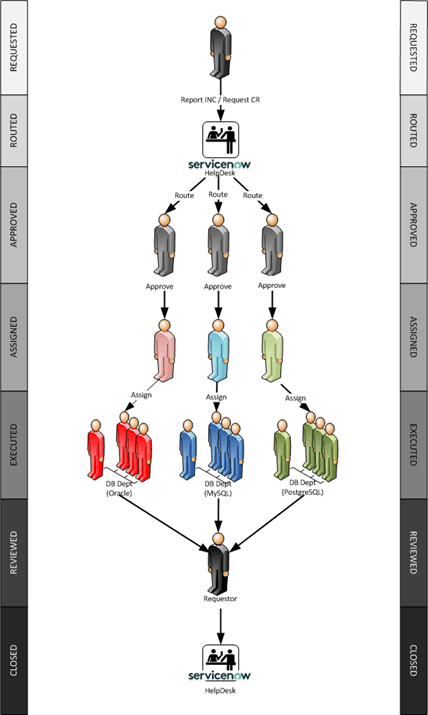
Here is the life cycle of a conventional IT change.
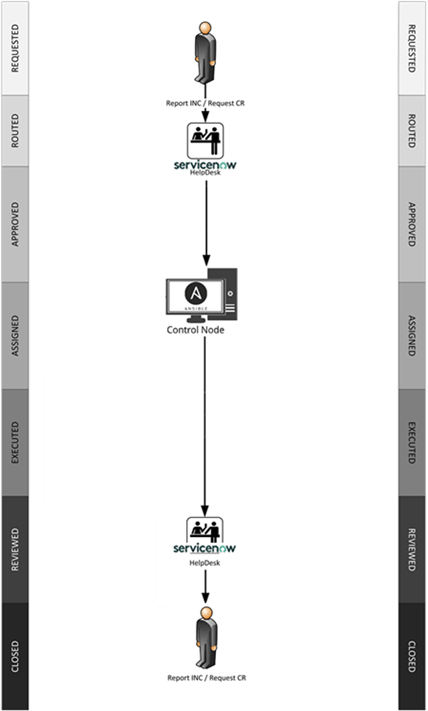
The assessment, routing, approval, and implementation stages alone may take weeks. The execution stage also often takes hours or even days. In some cases, the administrator may become ill or unavailable, prompting the escalation manager to seek an alternative. In the case of hyper-automation, however, there is no waiting. The delivery starts in seconds - be it an Incident resolution or a Change Request execution.
Here is another example: a long-running project, like fleet upgrade or DC migration (depicted below).
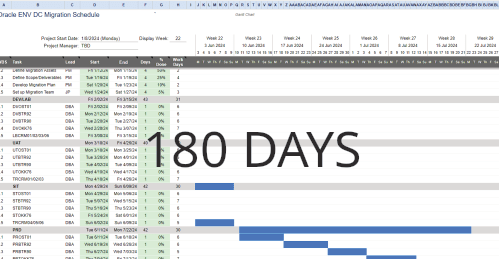
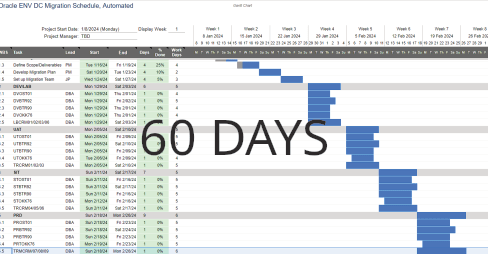
These take time for two reasons. Unlike robots, people don't work 24x7x365. They are also terrible at multi-tasking and tracking dependencies, especially if the project involves multiple parallel tasks executed by disparate teams, departments or business units. That is why hyper-automation is perfectly capable of condensing the same 6-month-long DC Migration project to just two short months.

|
|
 Low Cost Low Cost
What if you didn't have to hire a team of professionals to manually manage resource provisioning, asset configuration, issue troubleshooting, hardware setup, and so on? Automation saves time and money. How much money? Click to see just one example of what hyper-automation can do. > Click
|
> Click to collapse
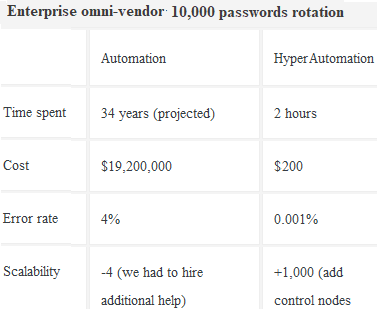
Here is a comparison of an omni-vendor enterprise-wide emergency password rotation, performed on 10,000 database assets at the same time to address an immediate security threat. It compares a conventionally automated activity with a hyper-automated one. Apart from the duration of the task dropping from 34 years (yes, that is how long the activity would take for a team of professionals to do this!) to only a couple of hours, the cost falls from $19.2 million dollars to $200.
 . .
You may ask: how is that even possible?
It became possible as soon as the manager assigned the emergency password rotation Change Request to a hyper-automated group, instead of a regular database team like the San Diego Database department group shown below. This department is not automated, of course.
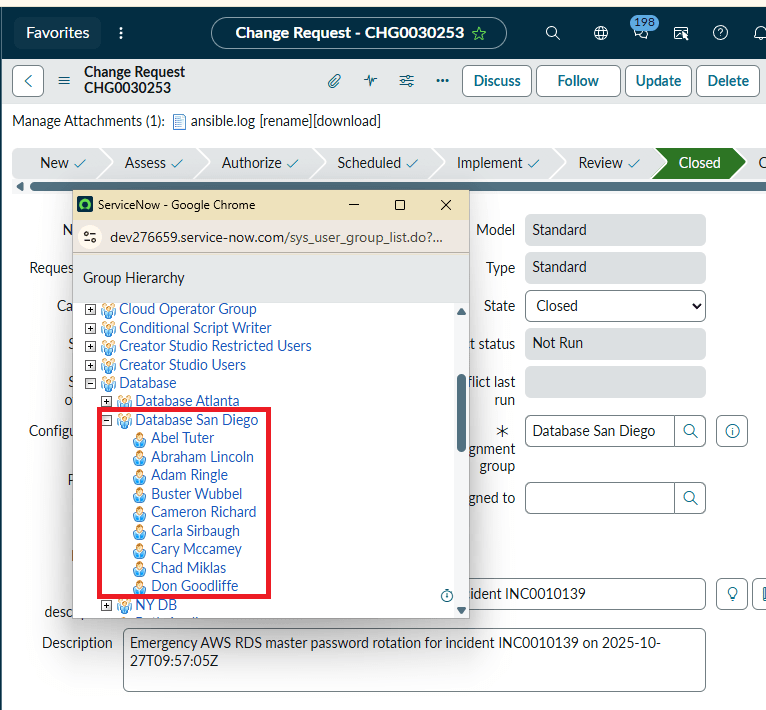
The conventional San Diego DBA team employs 9 top-notch database administrators at a cost of slightly over $1 million per year, plus benefits. These people work only certain hours a day and certain days a week. Their knowledge and experience are not interchangeable, meaning that what one employee knows and does, the next may not be able to replicate immediately. However, they are getting paid whether they are working, coasting, or entirely at rest. Even ServiceNow shows the hourly rate for the San Diego database administrator as $114/hr.
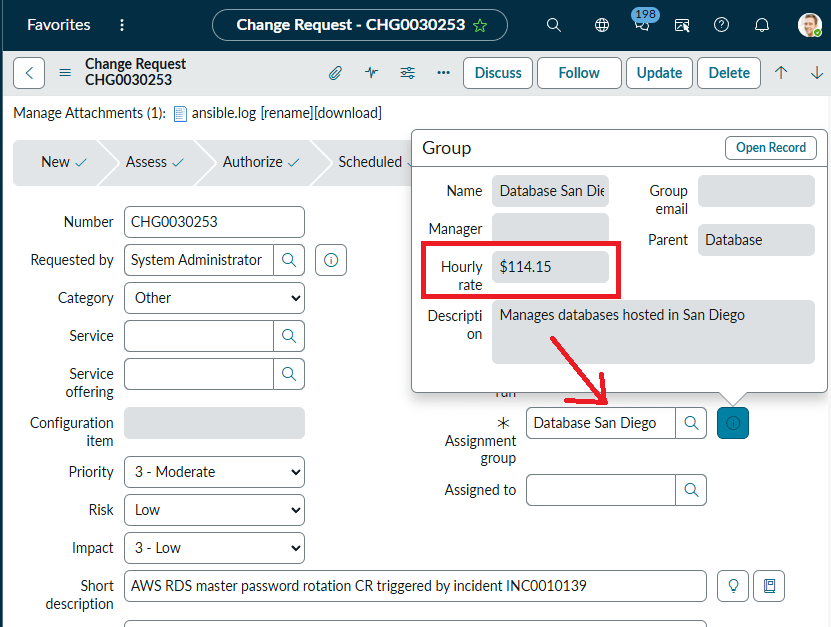
But that San Diego team was a conventional, unautomated department. Let's assign the same Change Request to a hyper-automated team instead. This department is the perfect candidate: "Database Atlanta". It employs only one administrator, Bow Ruggeri, and the second employee is a hyper-automation module ("Replayable" is the name of a product).
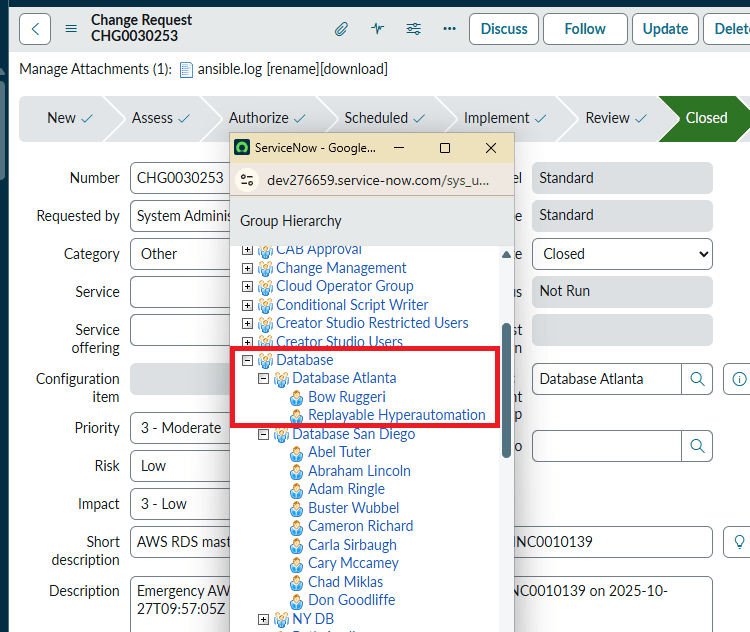
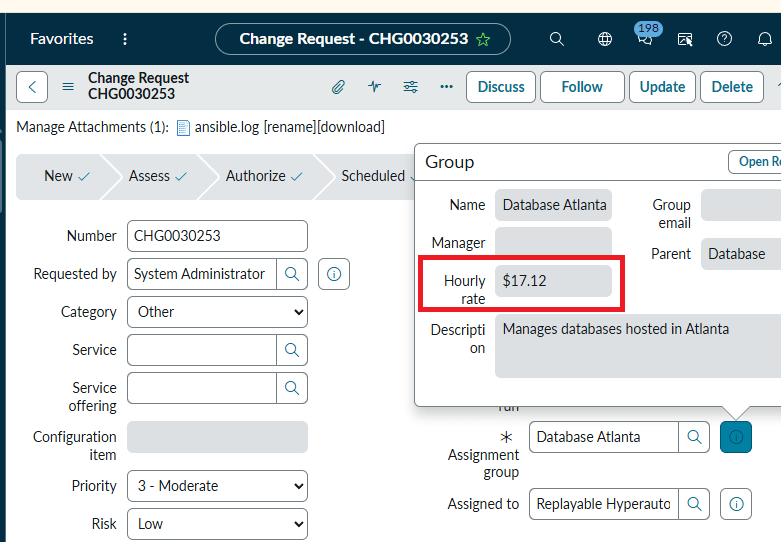
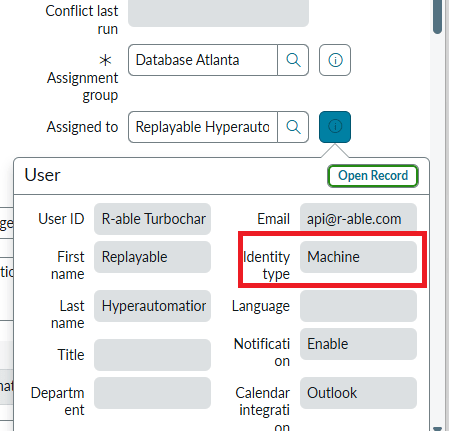
Yes, hyper automation software appears as an employee in ServiceNow, but a very special one. This employee never eats, sleeps, never has personal issues, or asks for a raise. It works round the clock, 24 by 7. It is 1,000 times more productive than the 9-count San Diego database administration team. Here is how much the hyper-automated Database Atlanta group costs the enterprise: $17.12 an hour.
Here is the hyper-automation module's HR entry in ServiceNow.
 . .
|
|
 High Quality High Quality
The accepted human error rate is around 4%. Hyper-automation operates in an error-free reality. Unlike humans, it runs precisely what must be run, where it must be run at the right time. That means projects are delivered faster, way below budgets, features released ahead of schedule — that means competitive edge, that means new customers, that means bonuses for all involved (except for the automation software that made that possible, of course!) > Click
|
> Click to collapse
People commit mistakes. That's a fact. No matter how much effort your team puts in, they are bound to make errors, several of them, in fact. This includes situations like running the wrong script, on the wrong database, not running it on time, not being prepared (not having the right password or connect string), not understanding the prerequisites or the handover process, and so on. In the case of Closed-Loop Automation, the execution logic remains unchanged. It doesn't depend on how much sleep the admin got the night before. It scans execution logs (sometimes thousands of them, in parallel) in real time as they are written. If it detects an error, it immediately opens an Incident in ServiceNow for the DBA to investigate the failed CR and attach the error log. It does not understand the concept of "good enough" and honestly thinks that 9-5 is just a number. Another way to describe hyper automation is that it is always at its best, 24x7x365. Not just at ITS best, but at the INDUSTRY's best, because whatever the technology or vendor, hyper-automation modules have vendors' best practices embedded. You execute the Change Requests and Resolve Incidents repeatedly, and get predictable results every single time. Automation=Quality=Control.
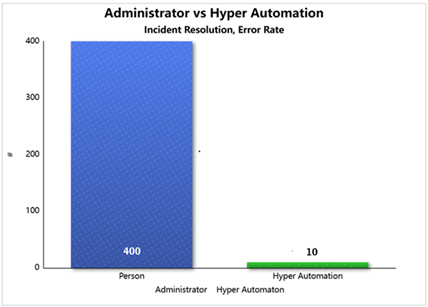
Here is the yearly error rate for Incident resolution, compared between a team of DBAs and a hyper-automation software.
|
|
 Ownership Ownership
Resource configuration is a labor- and skill-intensive task, usually handled by highly paid and sought after resources. When one of them leaves the organization, they take their knowledge with them. Not only that, the years of training you've invested in the person will start benefiting your competition from then on. The replacement you hire will require time, effort, and even more training to understand the predecessor's code, which he will ultimately discard to write his own. His effort, in turn, won't be reused either. With hyper-automation, the code always remains with the organization. > Click
|
> Click to collapse
What used to be physical (the servers) is now just definition code that explains to the Cloud what it is. You owe it to yourself to protect your investment. With hyper-automation, the task definitions and automation workflows never leave your repository, always properly secured, versioned, and tagged. The administrators don't even see the low level code, which runs by itself when the end-user clicks the "Submit" button in ServiceNow. The code doesn’t require DBA understanding, because it is modular. 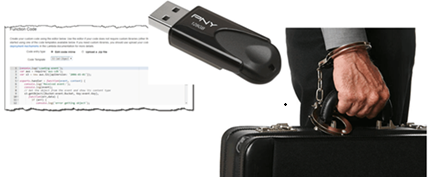
|
|
 Accountability Accountability
There is never any pointing fingers with our software. When you need to trace changes to definition files, you can do it with ease. They are versioned, so all changes are recorded for your review at a later time. So, once again, there's never any confusion on which module did what, when, where, and why. > Click
|
> Click to collapse
With the advent of the Cloud, it became almost impossible to keep up with different vendors and technologies. In the case of automation, the code is in a single source of truth.

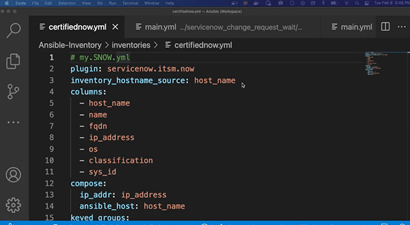
There is one centralized code repo (Github, Gitlab or similar), one encryption Vault for storing passwords/certificates, and one location for execution logs (ServiceNow ticketing), no matter which Cloud vendor or product is used. There's never any confusion about what the automation did, where, when and why. You execute it repeatedly and get predictable results every single time. There is never any finger-pointing, when it comes to IT services automation.
|
|
 Infinite Scalability Infinite Scalability
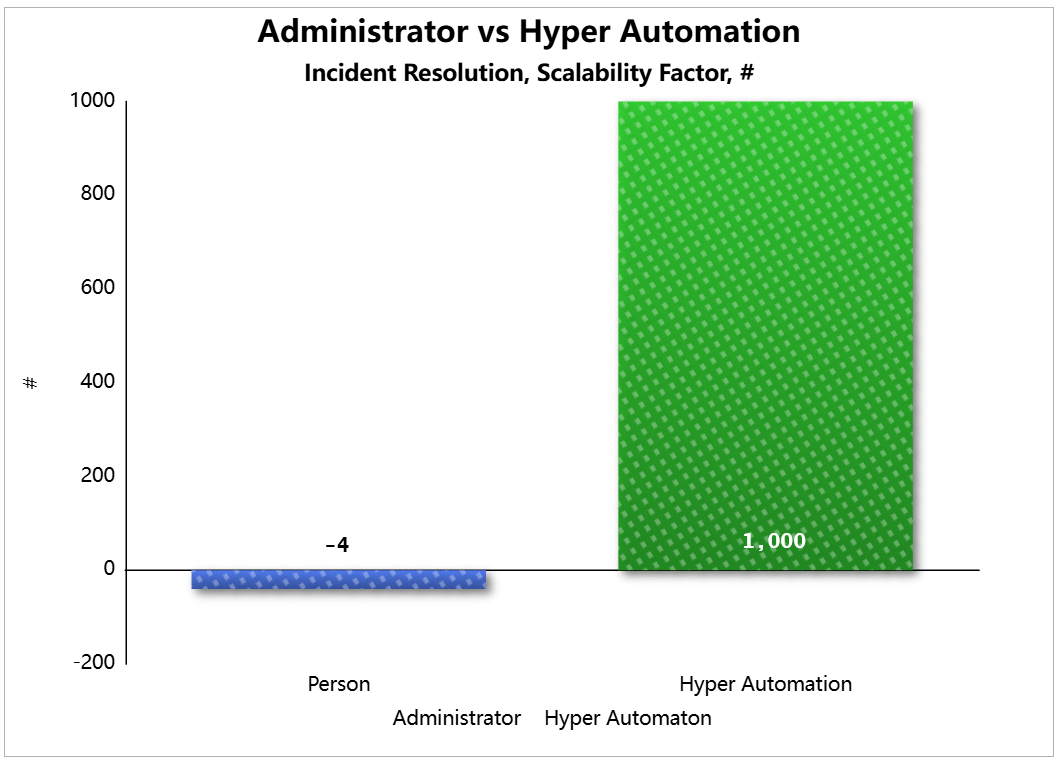
The automated solution can run 1,000 Change Requests at the same time, elevating admins from low-level button pushers and script runners to a more prestigious status as architects. With a Closed-Loop implementation, you may increase your workload exponentially before there is even a need for a Control Node upgrade. > Click
|
> Click to collapse

The load a current IT service management team carries can be increased by 5%–10%, and only for a few days. If the number or the priority of the requests is to double today, the process becomes unmanageable by the current headcount. It doesn’t matter how much money you throw at your employees. Overworked, they will eventually burn out and quit to serve your competitor.

Our closed-loop automation software will do an equally brilliant job whether it runs on one server or a thousand at the same time. The image below runs a Change Request on a server named "lnx1000" (that is a screenshot of the automation inventory file).
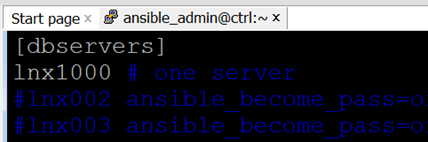
If you want the same task run on a thousand servers, all you have to do is to replace the "lnx1000" with "lnx[000:999]". The automation software will run the same CR on servers lnx000, lnx001, lnx002 ... and all the way to lnx999. A thousand of them!
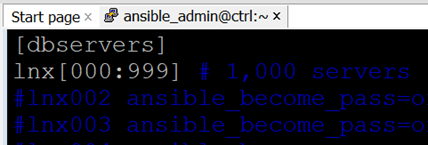
That is the equivalent of hiring a thousand DBAs on a moment's notice and releasing them just as quickly during a busy period, or when your company grows and expands. Our automation software will do an equally brilliant job, whether it works on one server or a thousand at the same time.
|
|
 Secure Encryption Secure Encryption
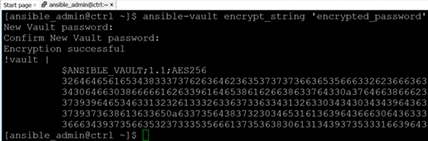
The automation uses the AES-256bit symmetric encryption algorithm. That means all sensitive data, whether in transit or at rest, is always encrypted: passwords, variables, certificates, API keys, and other credentials. The automation Vault prevents any sensitive data exposure, even once. The automation never leaves execution logs on the servers it manages; all logs are stored centrally in ServiceNow and Ansible. > Click
|
> Click to collapse

What is the best way of ensuring your mission-critical passwords are never distributed to unauthorized personnel? The answer is obvious. Do not distribute to any personnel at all. Let the robots handle the sensitive data. That is what they are best at.
Each instance of storing that password on a hard drive in clear text, even for a second, violates basic database security auditing rules. The same applies to unencrypted network communication. For a small company that may not pose a credible threat. However, large enterprises are often under strict auditing rules. Security violations are a matter of life and death. For example, if a quarterly audit finds elevated passwords stored on a server or transmitted via network, the auditing entity may revoke a long-standing contract. Hundreds of millions of dollars are at stake, and countless jobs are on the line.
|
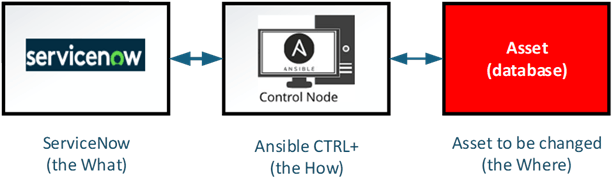
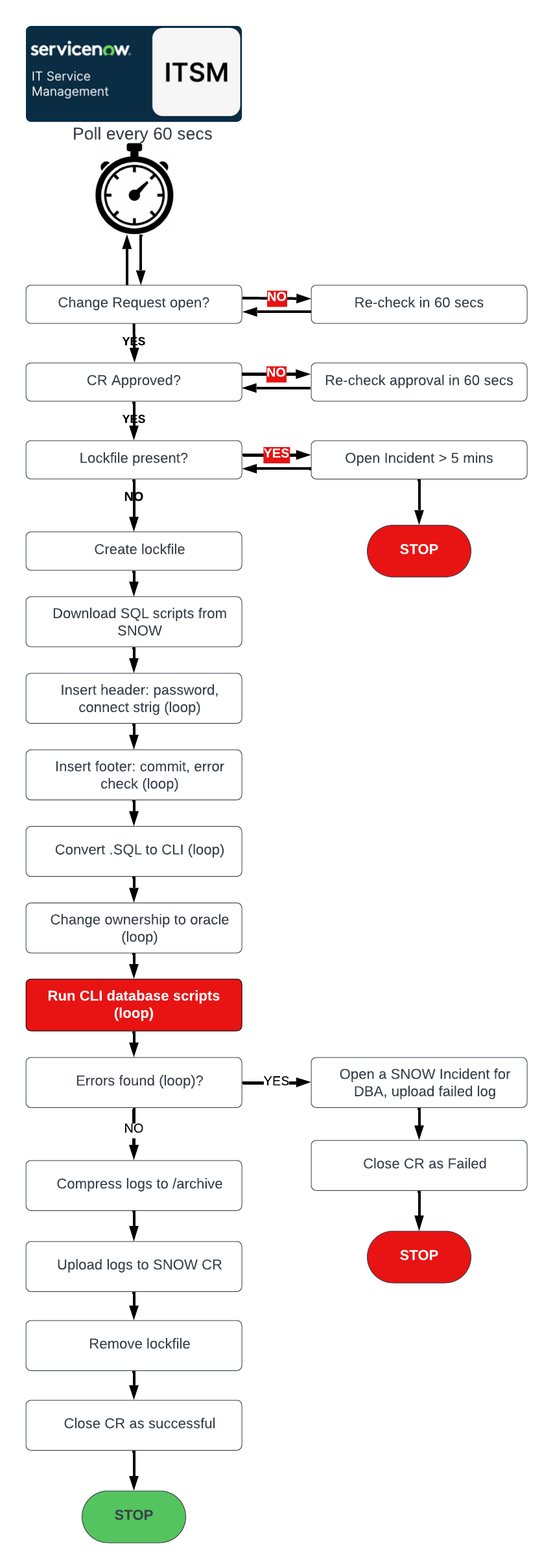
The following explains in very general terms how IT hyper-automation works.