
From On-Prem Oracle to AWS, Governed Every Step of the Way
Everything below describes where we're headed, not a shipped product. The ITIL alignment, risk mitigation, and cost containment you see elsewhere on this site are real and proven today. This page is our thinking on bringing that same governance to the single hardest, highest-stakes operation a DBA ever runs: moving off Oracle entirely.
This is what commoditized IT labor looks like in practice: the same governance a senior DBA would apply, arriving as infrastructure rather than headcount. Read our manifesto on why we think this is where all of skilled IT operations is headed.
The idea in one picture
A migration isn't one operation, it's a journey with real decision points along the way. Every one of those decision points is a place where the same governance you already trust for a routine password reset or schema refresh should apply — just scaled up for something with far higher stakes.
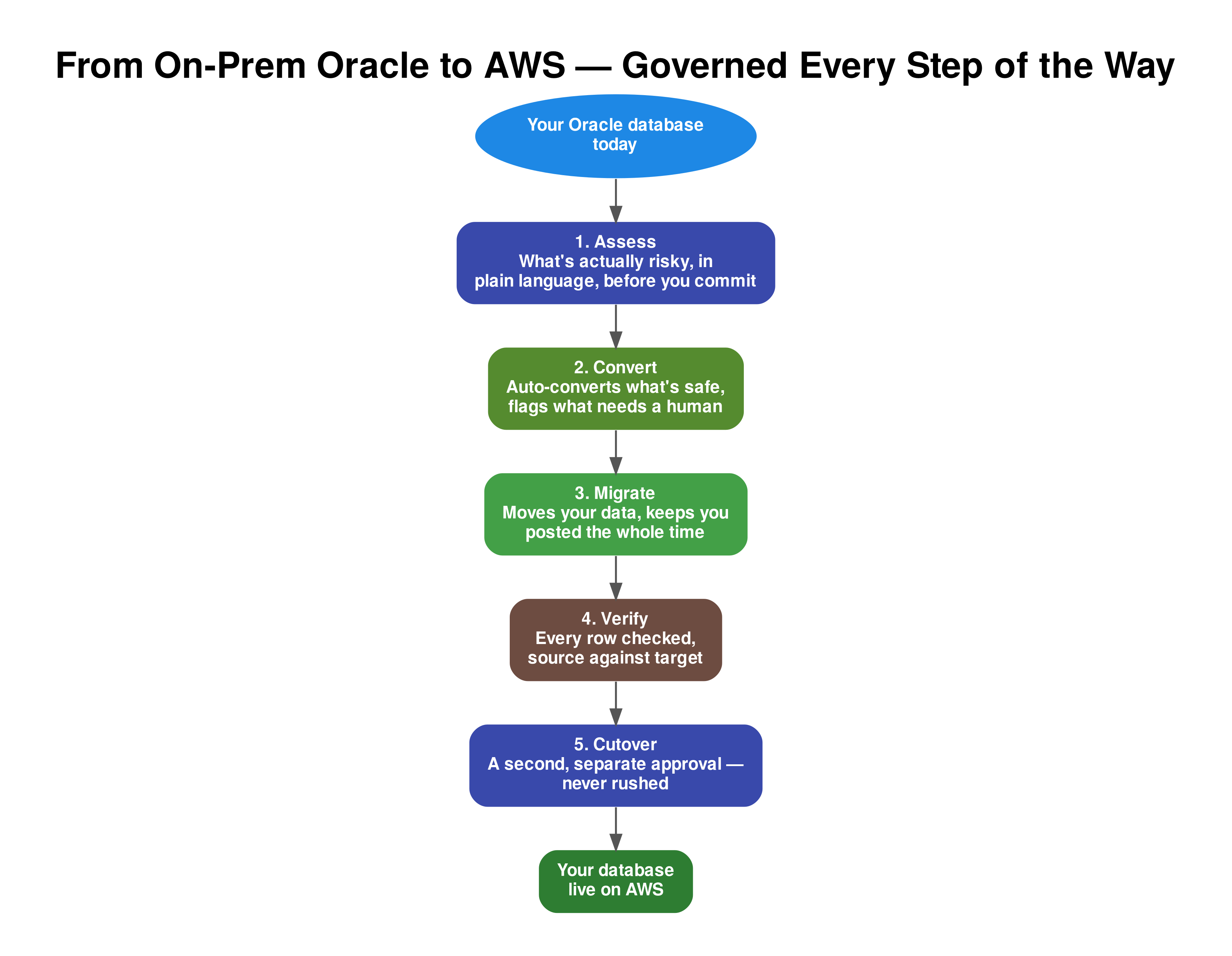
Four scenarios that show why this matters
1. The 2am surprise you never have
Imagine your team commits to a migration timeline, tools are purchased, a go-live date is on the calendar — and three weeks in, someone discovers a handful of custom PL/SQL functions with no direct equivalent on the target engine. The schedule slips. The budget conversation gets awkward. Nobody's fault, exactly — the complexity was always there, it just wasn't visible until it was expensive to find.
The alternative: an assessment that runs before anyone commits to a date, translating raw technical complexity into a plain-language risk rating and time estimate — with every risky object named specifically, not buried in a PDF nobody reads past page two.
2. The migration nobody has to babysit
A real data migration for a sizeable database can run for days. Today, that usually means someone keeps a browser tab open and refreshes a console every few hours — including overnight, including weekends — because if something stalls silently, nobody wants to be the one who didn't notice until morning.
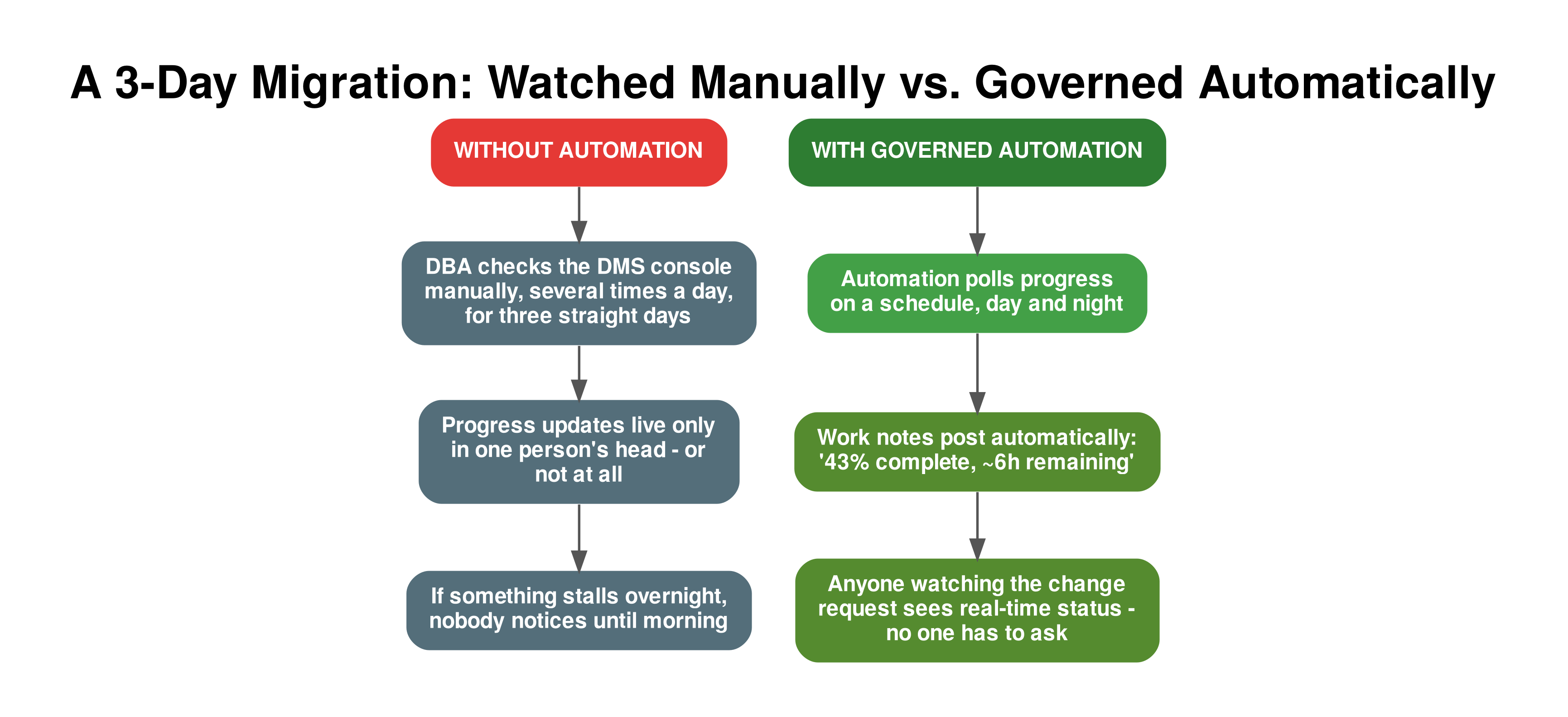
Governed automation checks in on itself — day and night — and posts real progress ("43% complete, roughly 6 hours remaining") where anyone with access to the change request can see it. No one has to ask. No one has to stay up.
3. The point of no return, done right
Imagine the migration has gone well for days — the team is tired, momentum says "let's just finish it" — and cutover, the one truly irreversible step, gets treated as a formality instead of the decision it actually is.
The alternative: cutover requires its own separate, fresh, time-boxed approval — one that never inherits the approval given days earlier at the start of the project. Momentum doesn't get to make the final call. A person does, deliberately, at the moment it actually matters.
4. The cleanup nobody forgets
Imagine a successful migration, everyone celebrates, everyone moves on to the next thing — and three weeks later, finance asks why a database migration tool is still running and still being billed. It happens more often than anyone likes to admit; temporary infrastructure has a way of quietly becoming permanent infrastructure.
The alternative: cleanup isn't a task on someone's to-do list, it's the automatic last step — the same cost-containment discipline already proven elsewhere in this platform, applied here too.
Manual Migration vs. Governed Automation
Every row below ties back to something specific in the actual design, not a generic claim — matching the same standard the rest of this platform holds to.
| Aspect | Manual Migration | Governed Automation |
| Complexity assessment | Discovered piecemeal, often mid-project, as engineers run into unconvertible objects one at a time | Full assessment before any commitment, complexity translated into plain-language risk rating and time estimate |
| Tracking what needs manual work | Buried in a static PDF/CSV report that's easy to lose track of as items get resolved | Every flagged object becomes its own tracked sub-task — visible progress, nothing silently forgotten |
| Progress visibility during migration | Someone manually checks a console every few hours, including overnight and weekends | Automatic scheduled progress updates posted where anyone with access can see them — no one has to ask, no one has to stay up |
| Data integrity verification | Spot-checked manually, coverage depends on how much time is left before the deadline | Every row and checksum compared automatically, source against target, before the process is allowed to proceed |
| Cutover decision | Often made informally under time pressure — "we're this close, let's just finish it" | Requires its own separate, fresh, time-boxed approval that never inherits the original project approval |
| Audit trail | Reconstructed after the fact from emails, chat logs, and memory — often incomplete | Every phase, decision, and approval is logged on the change request automatically, as it happens |
| Temporary infrastructure cleanup | A to-do item someone has to remember — migration tooling left running is a common, quiet cost leak | Automatic teardown is the final step of the process itself, not a task on anyone's list |
| Consistency across migrations | Depends on which engineer runs it and what they remember from the last one | Same governed process every time — the second migration benefits from everything learned building the first |
| Institutional knowledge risk | Concentrated in whoever ran the last migration — a real risk if that person leaves | Encoded in the automation itself, not dependent on one person's memory |
| Human error at scale | A missed step or fat-fingered command has real consequences, and is more likely under time pressure | The same tested sequence runs every time — no step gets skipped because someone was tired at hour 30 |
| Engineer time | Dominated by watching, waiting, and manually re-checking status | Freed up for the genuinely hard part — reviewing flagged objects and making judgment calls, not babysitting a console |
As with the rest of this page: the assessment row above reflects real, working automation today. The remaining rows describe the design we're building toward.
Where this stands today
The assessment stage — scenario 1 above — has real, working Ansible logic behind it today, built against AWS's actual DMS Schema Conversion APIs. The remaining stages are designed in detail but not yet built. We'd rather tell you exactly where the line is than let you assume more is finished than actually is.